How to Buy Cryptocurrency Through an Offline Exchange: Step-by-Step Guide
Want to buy cryptocurrency with cash without registering on exchanges or verifying documents? Offline exchanges can be a solution, but the rules have changed significantly.
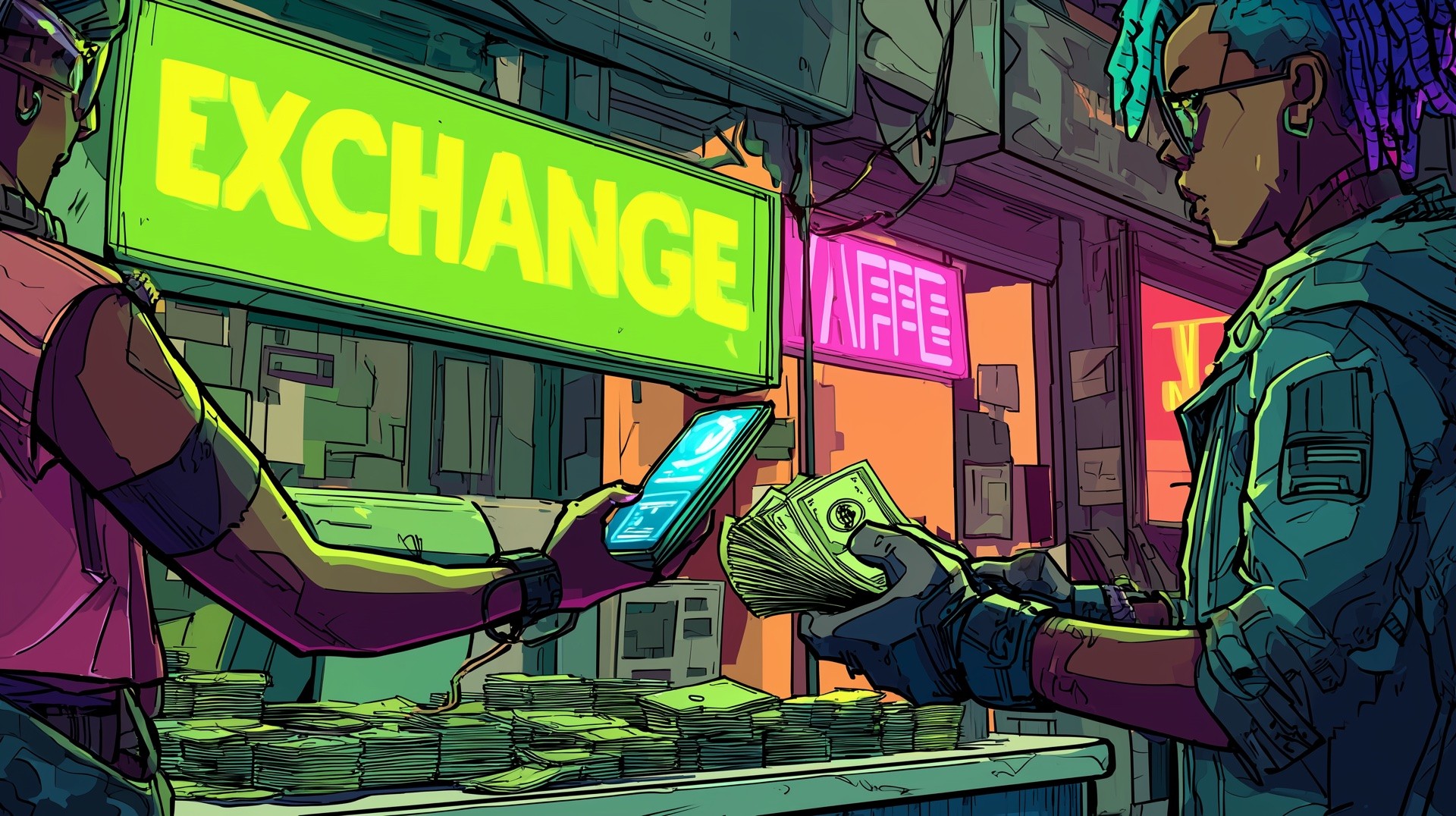
What Is an Offline Cryptocurrency Exchange
An offline exchange is an individual or office that exchanges cash for cryptocurrency. You arrive with cash, they send crypto to your wallet. No online registration or bank transfers required.
The process is simple: you arrange a meeting, arrive at the agreed location, show your wallet address, wait for the crypto to arrive, and hand over the cash. The entire transaction takes half an hour plus blockchain confirmation time.
The rules changed in 2024-2025 — many EU exchanges now require documents, and several post-Soviet countries are preparing new regulations. We'll cover the details in the legality section.
Key takeaway: offline exchanges solve accessibility problems when regular exchanges are unavailable or unsuitable.
When You Should Buy Cryptocurrency Through an Offline Exchange
Offline exchanges make sense in several cases. First — when centralized exchanges aren't available in your region. If Coinbase or Kraken are blocked and banks won't work with crypto companies, cash exchange remains your only option.
Second case — you don't have a bank card or you're having banking problems. Some European banks block transfers to exchanges, especially in countries like Italy or France. Cash doesn't have these issues.
Third — wanting to avoid online verification. While complete anonymity no longer exists, the procedure is simpler than on online exchanges.
Method | When It Makes Sense | Limitations | Fee |
Offline exchange | Exchanges unavailable in region, bank blocks transfers, no card | Risk of fraud, physical meeting | 1-5% |
Centralized exchange | Have bank card, exchange operates in country | Requires KYC, possible account freeze, fund holds | 0.1–1% + €1–5 withdrawal |
P2P platform | Exchanges unavailable in region or want simplified verification | Risk of dishonest seller, disputes | 0–1% + 2–7% spread |
Key takeaway: offline works when exchanges are unavailable or you want to avoid card blocking and fund freeze issues.
Where to Find a Reliable Offline Exchange
CryptoNavigator remains the main catalog of offline exchanges. On the site, you can select a city and set filters by exchange type. You'll see a list of available exchanges with contact information.
When choosing, pay attention to how long they've been operating — the longer an exchange has been in the market, the more reliable it is. Newcomers often disappear after a few months. Look for those who've been working for more than a year.
Always check reviews on Google and crypto forums. Search for the exchange name + "reviews" + "scam". You can also ask AI applications (ChatGPT, Perplexity) to check reviews and give you a summary. If the first results are complaints about stolen money, find another one.
Red flags that should concern you: demands for advance payment ("transfer 50 euros first for confirmation"), suspiciously good rates (5-10% better than market), meeting proposals in remote areas or private apartments.
Verification algorithm: find exchange → read reviews from the last 3 months → check website contacts (phone, messengers) → clarify rate and terms → arrange meeting in a public place (ideally in their office).
Check the offline exchange's legality in your country before the first transaction.
Key takeaway: reputation and reviews matter more than favorable rates — an extra 2% fee is better than losing all your money.
How to Prepare for a Meeting with an Exchange
For your first purchase, choose the largest coins — they're accepted everywhere and have the highest liquidity. Make sure the exchange works with your needed network (usually TRC-20 or ERC-20).
Create a wallet to receive cryptocurrency. Write down the seed phrase on paper and verify you can send and receive a test transfer of €5–10.
Popular wallet options: MetaMask, Trust Wallet, or Exodus. All three support major networks — Bitcoin, Ethereum, BSC, Polygon, Solana, Tron.
Calculate the amount including fees. If you want to receive €500 worth of cryptocurrency and the exchange fee is 4%, prepare €520. The rate is usually fixed at the time of agreement, but may change if the coin fluctuates significantly.
What to bring: cash (preferably the exact amount), smartphone with wallet access, personal documents in case they're required. Many exchanges now ask to see your passport.
Preliminary arrangement is mandatory. Call or write before the meeting, clarify the rate, amount, place, and time. Ask for a contact number to reach them on the day of the transaction.
Key takeaway: preparation takes longer than the transaction — don't rush.
How Much Does Buying Cryptocurrency Offline Cost
Offline exchanges earn on spread — the difference between buying and selling rates. This is usually 1-5% from the exchange rate, which is fixed in advance when arranging the meeting.
For small amounts up to €500, the spread can reach 4-9%. For large transactions from €5000, exchanges offer personalized terms — 1.5-4% with a dedicated manager.
For comparison — centralized exchange fees are 0.1-0.5% for trading plus 1-3% for card deposits. Offline is 2-3 times more expensive, but solves accessibility and blocking problems.
Offline is justified when exchanges are blocked, the bank won't process transfers, or you need maximum transaction speed.
Key takeaway: be prepared to overpay 2-4% for convenience and accessibility.
How a Transaction with an Offline Exchange Works
1. Preliminary Stage
Agreement: Contact the exchange to lock in the rate and amount. Clarify the availability of cash reserves and the exact office address.
Regulations: Learn the operating rules (whether documents are needed, what type of network is used, for example TRC-20 or ERC-20).
2. Arrival and Verification
Security: Conduct transactions only in the office. Never send assets in advance before a personal visit.
Update: On site, reconfirm the rate (if the coin is volatile) and provide documents for verification if required by the service rules.
3. Conducting the Transaction
Selling cryptocurrency: You fill out an application at the office → send crypto to the exchange address → after blockchain confirmation, receive cash.
Buying cryptocurrency: You hand over cash at the counter → provide your address (QR code) → the exchange sends crypto to your wallet.
4. Verification and Hash
Wallet address: Provide only your public address. Never show seed phrases or private keys to employees.
Control: Get the transaction hash (ID) from the exchange and verify it in a blockchain explorer. Make sure the address and amount are correct.
5. Completion
Waiting: Wait for actual funds to arrive in your wallet or for network confirmations to appear (usually 1 to 3 for different blockchains).
Finalization: The transaction is considered complete only after you see the balance change in your application.
Is It Safe to Buy Cryptocurrency Offline
Meeting location choice is critically important. Choose only exchanges with offices — the risks of encountering scammers are lower.
If something goes wrong — the exchange representative is nervous, demands money upfront, suggests changing the meeting place to somewhere more secluded — immediately terminate the transaction. Better to lose time than money.
Verifying cryptocurrency authenticity is simple: enter the transaction hash into blockchain.info (for bitcoin) or tronscan.org (for USDT TRC-20). If the transaction appears and the recipient address is yours — everything is fine.
Refuse the transaction immediately if: the exchange demands advance payment, asks to move to a more secluded location, can't show the transaction hash in the blockchain, is nervous or rushes you into a decision.
Key takeaway: your security is more important than any transaction — leave at the slightest suspicion.
Is It Legal to Buy Cryptocurrency Offline
Since late 2024, MiCA (Markets in Crypto Assets) regulation has been in effect in the EU. Legal operators must obtain a CASP (Crypto Asset Service Provider) license to work with fiat-to-crypto exchange. Practically, this means: most require documents, complete anonymity has disappeared.
Working with unlicensed operators can create legal problems with large amounts or regular operations.
The situation in post-Soviet countries is simpler:
— Ukraine, Kazakhstan and Georgia: cryptocurrency exchange through physical exchange points is possible and considered legal when regulatory requirements are met.
— Russia: the legal framework for offline exchanges in 2026 is still not fully formed, and such activity operates in a conditional gray zone without licensing.
Taxes are a separate topic. In most EU countries, capital gains tax applies when selling cryptocurrencies at a profit. Purchases are usually not taxed but require declaration for large amounts. Rates and rules depend on your country of residence.
Recommendation: consult with a local tax advisor if you plan regular operations or large amounts.
Key takeaway: the legal environment is changing rapidly — check current requirements in your country.
Which Mistakes to Avoid When Buying Cryptocurrency Offline
Mistake | Consequence | Correct Approach |
Wrong wallet address | Permanent cryptocurrency loss | Triple-check address, use QR code |
Meeting in unsafe location | Risk of robbery | Only public crowded places with cameras |
Handing over money before receiving crypto | Exchange fraud | Money strictly after blockchain confirmation |
Ignoring reputation check | Working with scammers | Search reviews, verify operating history |
Additional common mistakes: showing all cash upfront (attracts robbers), using an unverified wallet (risk of losing access), agreeing to "a small advance payment to confirm seriousness" (classic scammer scheme).
The most expensive mistake is rushing. Beginners fear the rate will change and agree to questionable terms. Remember: rates change in both directions, but lost money can't be recovered.
Key takeaway: spend an extra hour on verification rather than lose the entire amount due to haste.
What Alternatives Exist to Offline Cryptocurrency Exchanges
P2P platforms like Binance P2P allow buying directly from other users through bank transfers. Plus — more protection through escrow, minus — requires verification and a bank card. Fees are 0.1-2% compared to 1-5% for offline exchanges.
Crypto ATMs work like regular ATMs but sell cryptocurrency for cash. Plus — operate 24/7 without human factor, minus — high fees of 5-15% and limited geography.
Direct bank transfers to exchanges remain the cheapest method (SEPA in the EU costs €0.50-2), but can be blocked by banks or unavailable in your region.
Key takeaway: offline exchanges aren't the only way to buy without exchanges, explore all options.
FAQ
Can I buy crypto completely anonymously through an offline exchange? Depends on the country and exchange. In the EU since 2024, most require documents, small amounts are sometimes possible with minimal verification.
What to do if the exchange disappeared after receiving money? Contact police with evidence of the meeting. Meet in places with video surveillance for protection.
What's the minimum amount for buying through an offline exchange? Usually from €50-100. Depends on the specific exchange and city of operation.
Do I need to pay taxes on cryptocurrency purchases? In the EU and most other regions, taxes are usually on sales, not purchases. Clarify rules in your specific country.
Can I get money back if something goes wrong? No, blockchain transactions are irreversible. Carefully verify everything before handing over money.
How long does the entire purchase procedure take? 15-30 minutes for the meeting plus blockchain confirmation time. About one hour total.
Offline exchanges solve accessibility problems when exchanges are unavailable, but cost more than some methods. The situation changed in 2024-2025, but options still exist. Prepare thoroughly, meet safely, and remember — convenience costs more.
*Disclaimer: This article is for informational purposes only and is not a financial recommendation. Cryptocurrency investments carry high risks. Always conduct your own research and consult with financial advisors before making investment decisions.
Updated: