The business program focused on cross-border payments, banking integrations, digital assets, regulation, AML/KYT, stablecoins and the development of new financial platforms. These topics were unified by a broader question: what will financial infrastructure look like by 2030, and what role will banks, payment systems, crypto platforms and novel financial services play in it?

One of the main conclusions of FUTURUM PAYMENTS 2026 was the ongoing convergence of traditional finance  and the crypto industry. Banks are integrating digital assets and new payment infrastructures, crypto companies are expanding payment and financial services far beyond classic trading and compliance is becoming an essential prerequisite for collaboration between the two industries.

FUTURUM PAYMENTS 2026 FUTURUM PAYMENTS 2026

From Competition to a Shared Financial Infrastructure

Just a few years ago, banks and crypto companies operated largely as parallel financial ecosystems. Today the  model has shifted: payments, stablecoins, wallets, banking integrations and compliance are gradually forming a shared infrastructure where the boundary between traditional and digital finance is increasingly blurred.

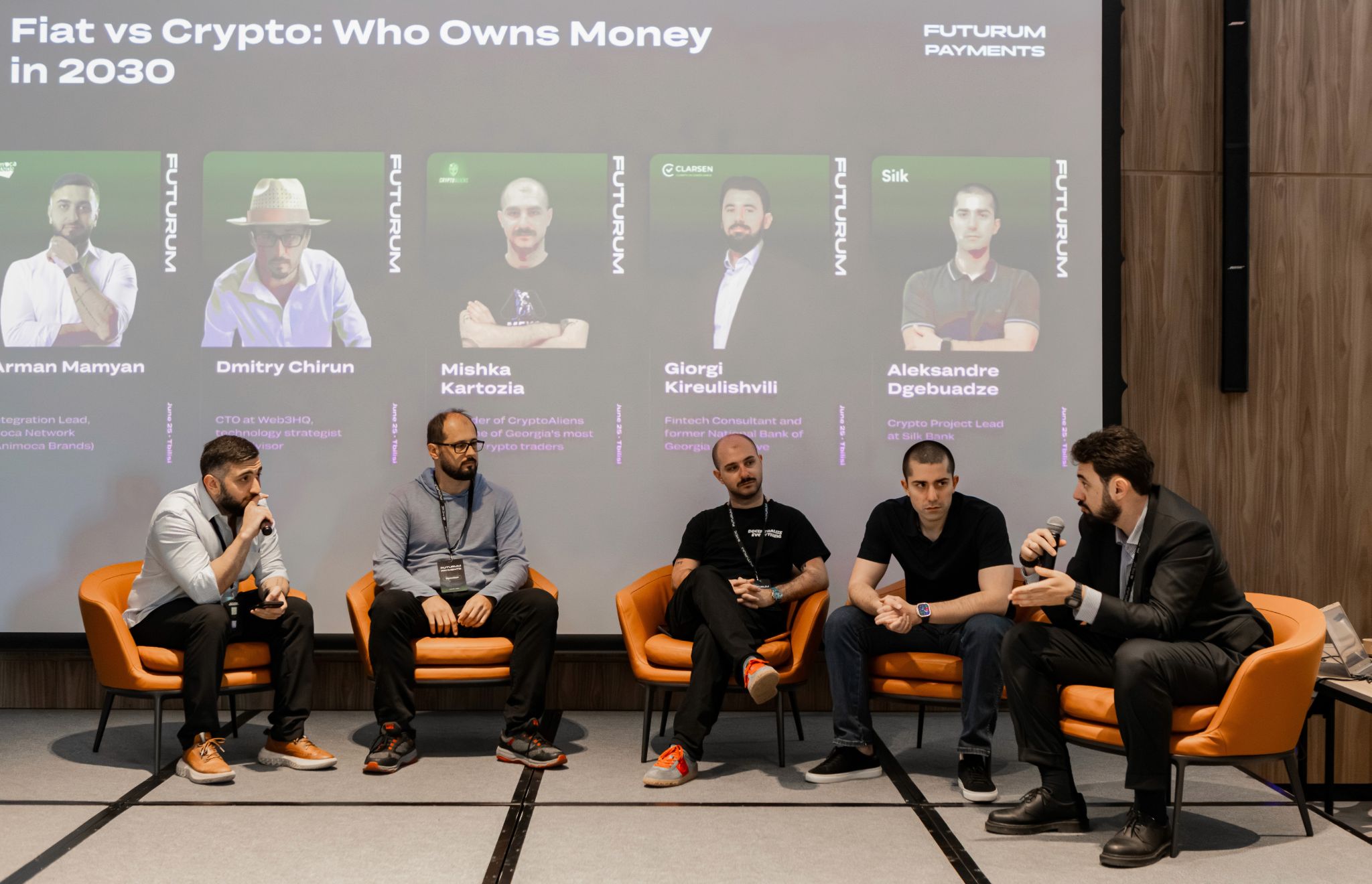
The future of the financial system was the core focus of the panel "Fiat vs Crypto: Who Owns Money in 2030?". However, the debate went far beyond the classic dichotomy of fiat vs cryptocurrency.

A key question was: which infrastructure will users rely on to manage their finances by 2030? Banks, payment systems, crypto exchanges, digital wallets, stablecoins and super-apps are gradually expanding their functionalities, increasingly competing for the same financial use cases - from asset storage and investing to payments and cross-border transfers.

Consequently, the competition of the next decade may not be between fiat and crypto themselves, but rather between different financial systems and models of access to financial services.

Representing Bitget at FUTURUM PAYMENTS 2026, Lili Malikova the  Marketing Manager (CIS), participated in the panel "The Adoption Rails: Why Exchanges are Becoming the Banks of Tomorrow." One of the core topics was the shifting role of crypto platforms from digital asset trading venues into comprehensive financial ecosystems.

In an exclusive comment for this piece, Gracy Chen, CEO of Bitget, shared how user behavior on the platform is changing in 2026: "The most notable change is that users are increasingly moving between different markets rather than limiting themselves exclusively to cryptocurrencies. In the first quarter, the share of traditional assets in Bitget's trading activity grew from practically zero to 20–40%. By June, equities peaked at 6.48% of daily trading activity and precious metals accounted for 40–55% of volume on highly active trading days.

An even more telling trend is observed in Bitget Wallet. In July, the wallet's user base surpassed 100 million, and for the first time in the platform's history, the number of users making daily payments exceeded the number of traders. This is an important behavioral signal: the wallet is increasingly being used not just for storing and managing assets, but as a tool for everyday financial operations.

Users are beginning to view crypto platforms as a hub for managing a broader range of investment opportunities and diverse asset classes. Payments are indeed becoming the next phase of the industry's evolution, particularly driven by stablecoins. However, our exchange data today most clearly highlights shifts in how people invest in and trade different asset classes."

These figures highlight two simultaneous shifts: users are moving beyond purely crypto assets while increasingly utilizing crypto infrastructure for their day-to-day financial needs. The growth of Bitget Wallet is particularly telling: with over 100 million users, daily payment users have surpassed active traders for the first time.

The transition from crypto primarily as an investment and trading tool to a broader financial infrastructure was one of the defining themes of FUTURUM PAYMENTS.

FUTURUM PAYMENTS 2026FUTURUM PAYMENTS 2026

Compliance as a Bridge Between Banks and Crypto

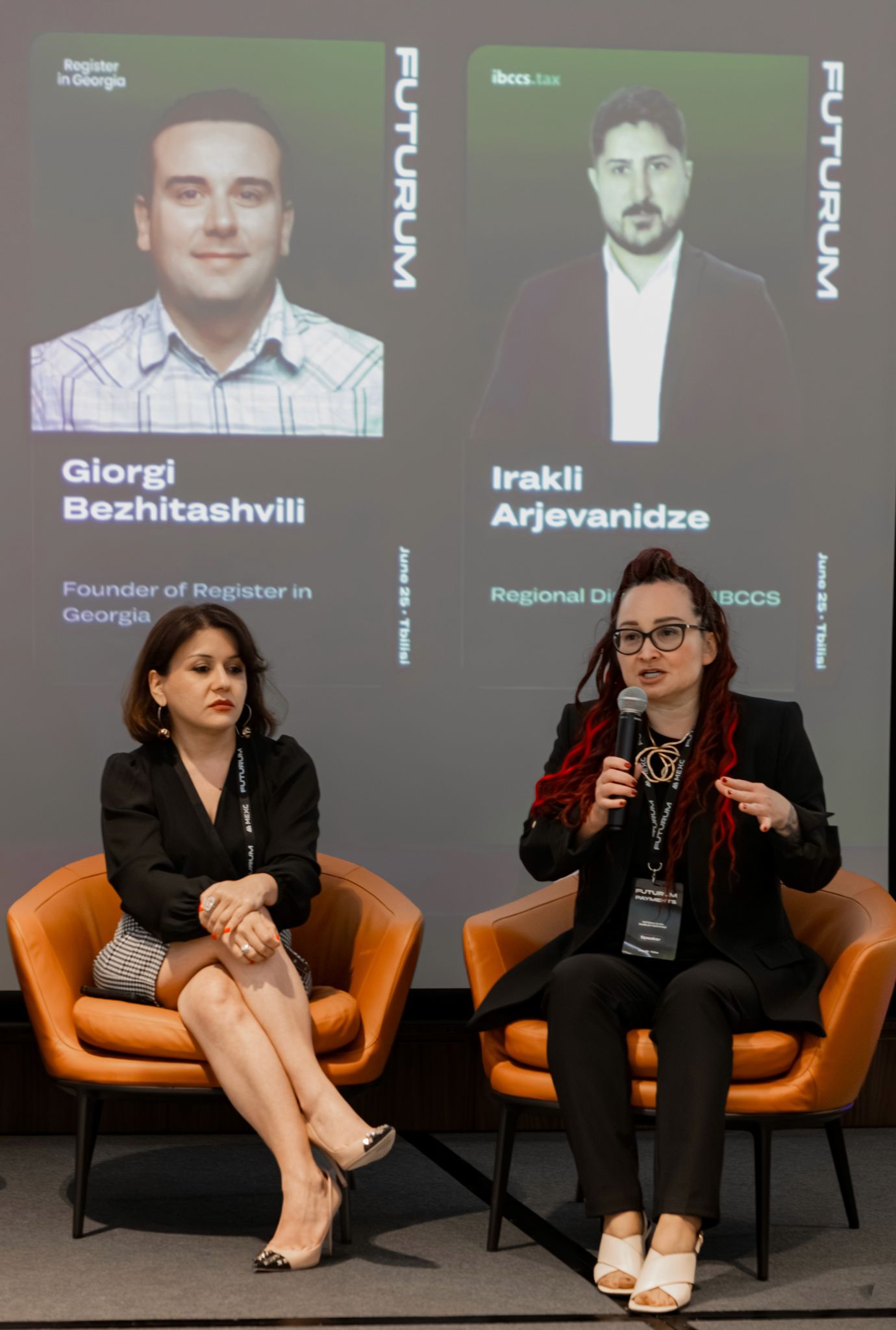
One of the central sessions was the legal panel "The Legal Bridge: How Compliance is Uniting Banks and Crypto."

Experts discussed the evolution of digital asset regulation, the compliance demands placed on global crypto businesses, and why compliance is transforming from a regulatory hurdle into the very infrastructure that enables banks and crypto companies to work together.

Tatyana-Elisa Baseley-Odrowąż, Founder of Baseley & Partners, noted: "Georgia can give a business a cost-efficient start. European expansion, however, requires a different level of regulatory readiness.

Dmitry Machikhin, Founder of BitOK, touched on the other side of increased oversight - AML/KYT, sanctions and restrictions: "Tether froze $822 million last year, which means we are no longer in a safe, decentralized haven. AML/KYT brings more transparency but, at the same time, tends to push some actors out with sanctions and restrictions where the reason isn't always clear."

The discussion highlighted a key paradox of the modern crypto industry: the closer digital assets get to mainstream finance, the more the surrounding infrastructure must operate under the rules of the global financial system.

Managing 20 Apps Is a Risk, Not a Convenience

A distinct perspective on the fragmentation of financial services was presented by Kirill Karapuz a Business Developer of Crypto Office. In his presentation "Stop switching between 20 apps. Do wallets, AML, and accounting in Telegram."

According to Karapuz, the challenge for modern crypto businesses is no longer a lack of tools but on the contrary, there are now too many. "Scattered tools are not an inconvenience, they are a risk: when wallets, AML, swaps and bookkeeping live in different places, you are not managing your money, you are hoping nothing breaks today. We brought it all into a single window so that businesses can manage their money in the very same place where they communicate."

FUTURUM PAYMENTS 2026FUTURUM PAYMENTS 2026

One of the most spirited debates occurred during the panel "The Adoption Rails: Why Exchanges are Becoming the Banks of Tomorrow."

While crypto exchanges were once associated primarily with buying and selling digital assets, today the largest platforms are building a much broader infrastructure: wallets, cards, payments, stablecoins, cross-border transfers and other financial services. Panelists discussed whether these platforms could eventually capture market share traditionally held by commercial banks.

Roman Degtiarev, Chief Analyst at GAUS Crypto, delivered one of the event's most candid predictions: "Liquidity attracts liquidity. Centralized exchanges will collapse into an oligopoly. Arguing otherwise is lying to ourselves."

The Evolution of Wealth Management

George Paliani, PBC, pointed out the transformation of another traditional financial sector synch as wealth advisory. "The next generation of wealth advisory is not about recommending products. It is about connecting capital, regulation, banking, opportunities and people into one coherent strategy."

Under this approach the wealth advisor of the future works not with standalone investment products, but with an entire ecosystem of capital, jurisdictions, banking solutions and investment avenues. 

Konstantin Tkachuk, Co-Founder and CSO at Titan Network took the discussion on blockchain’s role even further: "If the first killer feature of blockchain is stablecoins and coordinating money, the next is coordinating global infrastructure. At Titan Network, we are proving that the future of AI can be powered by the devices sitting idle in our own homes."

Thus, blockchain infrastructure is beginning to position itself as a coordination layer not just for finance, but for technology as well including distributed computing and AI.

Beyond the main program, FUTURUM PAYMENTS 2026 attendees held dozens of business meetings during networking sessions, discussing potential partnerships and new ventures.

About the Organizer

FUTURUM EVENT AGENCY is an international event agency specializing in fintech, blockchain, cryptocurrency, technology and investment events.

The team has organized over 100 events across 15 countries, including TOKEN2049 side events, major crypto conferences in the Caucasus, Binance events featuring CZ and various international tech and educational projects.

Contacts

FUTURUM PAYMENTS 2026: Banks, Fintech and Crypto Platforms Shape the Financial Infrastructure of 2030

FUTURUM PAYMENTS 2026 in Tbilisi brought together representatives from banking, the payments industry, fintech companies, the crypto market and the investment and legal communities. Event partners, participants and guests included representatives from Mastercard, PBC, TBC, Bitget, Gate.com, Hashbank, Silk Bank, BitOK, BLC Law Office, Crypto Office, GAUS Crypto, Cryptal, and other leading financial market players.

6 min read

FUTURUM PAYMENTS 2026

The business program focused on cross-border payments, banking integrations, digital assets, regulation, AML/KYT, stablecoins and the development of new financial platforms. These topics were unified by a broader question: what will financial infrastructure look like by 2030, and what role will banks, payment systems, crypto platforms and novel financial services play in it?

One of the main conclusions of FUTURUM PAYMENTS 2026 was the ongoing convergence of traditional finance  and the crypto industry. Banks are integrating digital assets and new payment infrastructures, crypto companies are expanding payment and financial services far beyond classic trading and compliance is becoming an essential prerequisite for collaboration between the two industries.


FUTURUM PAYMENTS 2026 FUTURUM PAYMENTS 2026

From Competition to a Shared Financial Infrastructure

Just a few years ago, banks and crypto companies operated largely as parallel financial ecosystems. Today the  model has shifted: payments, stablecoins, wallets, banking integrations and compliance are gradually forming a shared infrastructure where the boundary between traditional and digital finance is increasingly blurred.

The future of the financial system was the core focus of the panel "Fiat vs Crypto: Who Owns Money in 2030?". However, the debate went far beyond the classic dichotomy of fiat vs cryptocurrency.

A key question was: which infrastructure will users rely on to manage their finances by 2030? Banks, payment systems, crypto exchanges, digital wallets, stablecoins and super-apps are gradually expanding their functionalities, increasingly competing for the same financial use cases - from asset storage and investing to payments and cross-border transfers.

Consequently, the competition of the next decade may not be between fiat and crypto themselves, but rather between different financial systems and models of access to financial services.

Representing Bitget at FUTURUM PAYMENTS 2026, Lili Malikova the  Marketing Manager (CIS), participated in the panel "The Adoption Rails: Why Exchanges are Becoming the Banks of Tomorrow." One of the core topics was the shifting role of crypto platforms from digital asset trading venues into comprehensive financial ecosystems.

In an exclusive comment for this piece, Gracy Chen, CEO of Bitget, shared how user behavior on the platform is changing in 2026: "The most notable change is that users are increasingly moving between different markets rather than limiting themselves exclusively to cryptocurrencies. In the first quarter, the share of traditional assets in Bitget's trading activity grew from practically zero to 20–40%. By June, equities peaked at 6.48% of daily trading activity and precious metals accounted for 40–55% of volume on highly active trading days.

An even more telling trend is observed in Bitget Wallet. In July, the wallet's user base surpassed 100 million, and for the first time in the platform's history, the number of users making daily payments exceeded the number of traders. This is an important behavioral signal: the wallet is increasingly being used not just for storing and managing assets, but as a tool for everyday financial operations.

Users are beginning to view crypto platforms as a hub for managing a broader range of investment opportunities and diverse asset classes. Payments are indeed becoming the next phase of the industry's evolution, particularly driven by stablecoins. However, our exchange data today most clearly highlights shifts in how people invest in and trade different asset classes."

These figures highlight two simultaneous shifts: users are moving beyond purely crypto assets while increasingly utilizing crypto infrastructure for their day-to-day financial needs. The growth of Bitget Wallet is particularly telling: with over 100 million users, daily payment users have surpassed active traders for the first time.

The transition from crypto primarily as an investment and trading tool to a broader financial infrastructure was one of the defining themes of FUTURUM PAYMENTS.
FUTURUM PAYMENTS 2026FUTURUM PAYMENTS 2026

Compliance as a Bridge Between Banks and Crypto

One of the central sessions was the legal panel "The Legal Bridge: How Compliance is Uniting Banks and Crypto."

Experts discussed the evolution of digital asset regulation, the compliance demands placed on global crypto businesses, and why compliance is transforming from a regulatory hurdle into the very infrastructure that enables banks and crypto companies to work together.

Tatyana-Elisa Baseley-Odrowąż, Founder of Baseley & Partners, noted: "Georgia can give a business a cost-efficient start. European expansion, however, requires a different level of regulatory readiness.

Dmitry Machikhin, Founder of BitOK, touched on the other side of increased oversight - AML/KYT, sanctions and restrictions: "Tether froze $822 million last year, which means we are no longer in a safe, decentralized haven. AML/KYT brings more transparency but, at the same time, tends to push some actors out with sanctions and restrictions where the reason isn't always clear."

The discussion highlighted a key paradox of the modern crypto industry: the closer digital assets get to mainstream finance, the more the surrounding infrastructure must operate under the rules of the global financial system.

Managing 20 Apps Is a Risk, Not a Convenience

A distinct perspective on the fragmentation of financial services was presented by Kirill Karapuz a Business Developer of Crypto Office. In his presentation "Stop switching between 20 apps. Do wallets, AML, and accounting in Telegram."

According to Karapuz, the challenge for modern crypto businesses is no longer a lack of tools but on the contrary, there are now too many. "Scattered tools are not an inconvenience, they are a risk: when wallets, AML, swaps and bookkeeping live in different places, you are not managing your money, you are hoping nothing breaks today. We brought it all into a single window so that businesses can manage their money in the very same place where they communicate."
FUTURUM PAYMENTS 2026FUTURUM PAYMENTS 2026

One of the most spirited debates occurred during the panel "The Adoption Rails: Why Exchanges are Becoming the Banks of Tomorrow."

While crypto exchanges were once associated primarily with buying and selling digital assets, today the largest platforms are building a much broader infrastructure: wallets, cards, payments, stablecoins, cross-border transfers and other financial services. Panelists discussed whether these platforms could eventually capture market share traditionally held by commercial banks.

Roman Degtiarev, Chief Analyst at GAUS Crypto, delivered one of the event's most candid predictions: "Liquidity attracts liquidity. Centralized exchanges will collapse into an oligopoly. Arguing otherwise is lying to ourselves."

The Evolution of Wealth Management

George Paliani, PBC, pointed out the transformation of another traditional financial sector synch as wealth advisory. "The next generation of wealth advisory is not about recommending products. It is about connecting capital, regulation, banking, opportunities and people into one coherent strategy."

Under this approach the wealth advisor of the future works not with standalone investment products, but with an entire ecosystem of capital, jurisdictions, banking solutions and investment avenues. 

Konstantin Tkachuk, Co-Founder and CSO at Titan Network took the discussion on blockchain’s role even further: "If the first killer feature of blockchain is stablecoins and coordinating money, the next is coordinating global infrastructure. At Titan Network, we are proving that the future of AI can be powered by the devices sitting idle in our own homes."

Thus, blockchain infrastructure is beginning to position itself as a coordination layer not just for finance, but for technology as well including distributed computing and AI.

Beyond the main program, FUTURUM PAYMENTS 2026 attendees held dozens of business meetings during networking sessions, discussing potential partnerships and new ventures.

About the Organizer

FUTURUM EVENT AGENCY is an international event agency specializing in fintech, blockchain, cryptocurrency, technology and investment events.

The team has organized over 100 events across 15 countries, including TOKEN2049 side events, major crypto conferences in the Caucasus, Binance events featuring CZ and various international tech and educational projects.

Contacts

Updated:

Promotional Post

The author is not affiliated with the Crypto Navigator editorial board. The materials presented on this site are not a recommendation to buy or sell any assets. The opinion of the editorial board may not coincide with the opinion of the author.

Author

FUTURUM EVENT AGENCY

FUTURUM is an international event agency specializing in iGaming, crypto, and IT events.

The agency creates premium experiences for global brands and organizes iconic side events during TOKEN2049, SBC, Sigma, and MONEY2020. FUTURUM helps companies expand into international markets, including LatAm, CIS, MENA, Asia, and the Caucasus — enabling them to confidently establish their presence and build strategic connections in the region. The agency manages the full event cycle: from venue selection and vendor coordination to speaker curation, VIP guest engagement, event operations, and marketing strategy tailored to target audiences. Core Services: Meetups & Private Events, Large-Scale Conferences, Roadshows, General Sponsorships, Side Events, IT Camps, Corporate Events. Clients: OKX, Binance, MEXC, Gate, XDAO, CoinsPaid, and others.

Author

FUTURUM EVENT AGENCY

FUTURUM is an international event agency specializing in iGaming, crypto, and IT events.

The agency creates premium experiences for global brands and organizes iconic side events during TOKEN2049, SBC, Sigma, and MONEY2020. FUTURUM helps companies expand into international markets, including LatAm, CIS, MENA, Asia, and the Caucasus — enabling them to confidently establish their presence and build strategic connections in the region. The agency manages the full event cycle: from venue selection and vendor coordination to speaker curation, VIP guest engagement, event operations, and marketing strategy tailored to target audiences. Core Services: Meetups & Private Events, Large-Scale Conferences, Roadshows, General Sponsorships, Side Events, IT Camps, Corporate Events. Clients: OKX, Binance, MEXC, Gate, XDAO, CoinsPaid, and others.

Last articles

CONTACTS ★ CONTACTS ★